
Articles

Logotipo de Clínica Synaptica con texto gris y turquesa y una raya amarilla

Read in-depth articles about psychedelic-assisted therapy, with a special focus on ketamine treatments and their impact on mental health.

Glass bottles, scales, a squash and candles on a table

Psychedelic Substances And Their Use In Contemporary Psychiatry

Psychiatry is undergoing a renaissance in the use of psychedelic substances to treat treatment-resistant depression, anxiety, and PTSD. A look at their history, prohibition, and the recognition owed to the indigenous peoples who preserved this knowledge for centuries.


...
Grey jigsaw puzzle pieces scattered on a light surface

Understanding MDMA-Assisted Psychotherapy

MDMA, first synthesized in 1912, has moved from recreational use to becoming the focus of growing scientific interest for its therapeutic potential. Discover how it works, its role in PTSD treatment, and what other clinical applications are currently being explored.

...
Web of black strings and interlinked nodes on a pale background

How Can Ketamine Therapy Help You?

Ketamine therapy has gained relevance in mental health as an option for treatment-resistant depression, anxiety, and PTSD. Discover how it works, what a session involves, and why it’s often combined with psychotherapy as part of a comprehensive approach.

...
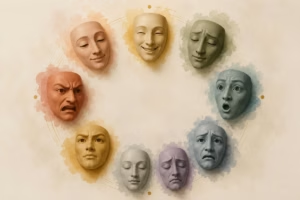
Illustration of faces showing different emotions arranged in a circle

Navarasa: An Ancient Indian Practice for Making Space for Emotions

What if, instead of fighting difficult emotions, we learned to greet them? Navarasa is an ancient Indian practice that invites us to recognize nine fundamental emotional states — from joy to anger — and consciously make room for them, without letting them run the show.

...
Two sculpted faces with closed eyes against a black background

Rewiring the Soul: 5 Surprising Ways Psychedelics Reshape Who We Are

For centuries we believed personality was fixed, carved in stone by adulthood. A new systematic review — analyzing 48 studies on psilocybin, LSD, and ayahuasca — suggests otherwise: our deepest traits, from Openness to Neuroticism, may be far more malleable than we thought. We explore five key findings from psychedelic science and the philosophical questions they raise about the “self.”

...
Swirls of blue and pink smoke on a purple background

Nitrous oxide for the treatment of depression

Nitrous oxide is a gas that has been used in various fields for many years. Recently, new research points to its potential for treating depression, with rapid action and short, transient side effects.

...
Interview thumbnail with Josep Fericgla, KAP training 2025 in Barcelona

Interview with Josep Fericgla

We listen to Josep Maria Fericgla, anthropologist, writer, and founder of the Can Benet spirituality center, recount the experiences that have shaped his life.

...
Rushing water with blue and golden reflections

What is a psychedelic experience like?

This blog explores what a psychedelic experience might feel like through a symbolic fable. Using metaphors and imaginary characters, it tells a story that invites reflection on what is truly important in the psychedelic journey.

...
Tree canopy with long hanging seed pods against a blue sky

New Therapeutic Perspectives for Depression: 5-MeO-DMT

New therapies and treatments for depression and other mental health disorders are constantly being researched and developed. One of the most promising avenues currently under investigation is psychotherapy with 5-MeO-DMT, a short-acting psychoactive substance.

...
Thumbnail of the interview with Phil Wolfson from the 2025 ketamine training in Barcelona

Phil Wolfson: an in-depth interview

In this engaging interview conducted by Dr. Joan Obiols, Phil Wolfson, founder of the Ketamine Research Foundation, speaks passionately about the pivotal events in his life and what led him to become a world-renowned expert in ketamine-assisted psychotherapy.

...
Hourglass with blue sand on a stone floor

Ketamine: chronology of a clinical revolution

Ketamine’s clinical journey spans more than six decades, evolving from a battlefield anesthetic to a groundbreaking therapeutic tool in mental health. Its history reflects a convergence of neurobiological discovery, clinical intuition, and unmet therapeutic needs, leading to its current role in the treatment of depression, addiction, and treatment-resistant conditions. This article explores the key milestones that have shaped ketamine’s evolution and its relevance in contemporary psychiatric practice.

...
Busy street at night with moving traffic and street stalls

Ketamine for anxiety: a simple guide to new findings

Anxiety disorders are increasingly prevalent and often respond poorly to standard treatments such as SSRIs or benzodiazepines. Growing evidence suggests ketamine-assisted psychotherapy may offer rapid relief, particularly in treatment-resistant anxiety. By modulating glutamate via NMDA and AMPA receptors, ketamine enhances neuroplasticity and may reduce pathological worry within hours or days. Clinical trials show benefits in social and generalized anxiety, and real-world studies report sustained symptom reduction and decreased suicidal ideation. When combined with psychotherapy and integration, ketamine may help consolidate meaningful and lasting change.

...
Aerial view of a river winding through forests

The potential of ayahuasca assisted with psychotherapy in acute grief processes: a scientific and artistic exploration

Recent research suggests ayahuasca-assisted psychotherapy may support people facing acute grief. In a structured therapeutic setting, ayahuasca was associated with reduced grief severity, fewer prolonged-grief symptoms, and greater post-traumatic growth. The study compared ayahuasca-assisted therapy, psychotherapy alone, and no intervention, finding the strongest improvements when ritual, psychotherapy, and community support were combined. Results indicate ayahuasca may help integrate loss by easing pain while preserving emotional connection to the deceased, offering a humane complement to existing grief care within ethically guided clinical frameworks.

...
White neuron-like branches on a black background

Neuroplasticity and ketamine: a new horizon in mental health

Depression, anxiety and chronic stress are associated with the loss and retraction of dendritic spines, disrupting communication between key brain regions involved in emotion, memory and decision-making. This disconnection reduces cognitive flexibility and promotes rumination and rigid negative patterns. Ketamine and other psychedelics have been shown to rapidly enhance neuroplasticity by increasing the formation and stabilization of dendritic spines, reopening critical learning periods. When combined with psychotherapy and supportive habits, this window of plasticity can facilitate lasting emotional and behavioral change.

...
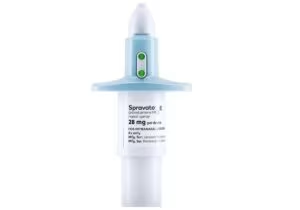
Medication nasal spray on a white background

Are S-Ketamine (Esketamine) and R-Ketamine the same?

This article explains the key differences and similarities between ketamine and esketamine in the treatment of resistant depression. It reviews their shared glutamatergic mechanisms, distinct stereoisomeric forms, routes of administration and side effect profiles. Evidence from preclinical and clinical studies suggests racemic ketamine and R-ketamine may offer longer lasting antidepressant effects and fewer adverse reactions than S-ketamine. The text also addresses subjective experiences, dissociative effects, cost, regulatory issues and why many clinics prioritize racemic ketamine in personalized, evidence based care.

...
Capsules, flowers, dropper bottles and test tubes on a yellow background

Ketamine administration methods

Ketamine-assisted psychotherapy can use several routes of administration, each with different pharmacokinetic profiles. This article explains bioavailability and half-life, and compares intramuscular, intranasal and oral ketamine. Intramuscular administration offers very high bioavailability, rapid onset and longer half-life, while intranasal delivery has moderate bioavailability and shorter duration, and oral use shows slower onset and lower absorption. Based on these factors, the clinic prioritizes intramuscular injection as a balanced option combining efficacy, predictability, patient comfort and clinical safety in routine ketamine-assisted psychotherapy settings.

...
Cluster of brown-capped mushrooms in a glass bowl

Psilocybin – what is it, and what is its current legal status?

Psilocybin is a naturally occurring psychedelic found in certain mushrooms with a long history of ritual use. Research shows it can alter perception, mood and sense of self, often producing meaningful or mystical experiences. Recent studies highlight potential benefits for depression, anxiety, addiction and grief, linked to temporary increases in brain connectivity and neuroplasticity. Evidence supports structured, high-dose sessions combined with psychotherapy, while microdosing lacks solid support. Despite advanced clinical trials in the US and Europe, psilocybin remains illegal in Spain and is not offered clinically.

...
Dropper releasing a drop into an amber glass bottle

Microdosing psychedelics: potential benefits and current evidence

Microdosing psychedelics involves taking sub-perceptual doses of substances such as psilocybin or LSD with the aim of improving mood, cognition and emotional wellbeing. This article reviews current scientific evidence on microdosing, including proposed neurobiological mechanisms, potential benefits for depression and anxiety, cognitive and motivational effects, safety considerations and the role of placebo. While observational studies suggest possible benefits, controlled trials show mixed results, highlighting important limitations and the need for further rigorous research before clear clinical recommendations can be made.

...
White mushroom beside a vial of injectable medication

Ketamine vs. psilocybin therapy: a comparative overview

This article compares ketamine and psilocybin-assisted therapies, outlining differences in legality, mechanisms of action, therapeutic uses, safety profiles and patient experience. Ketamine is legally available and offers rapid symptom relief through glutamatergic modulation, making it useful in acute depression and suicidality. Psilocybin, currently illegal outside trials in Spain, acts via serotonin receptors and is associated with longer-lasting psychological change. The article highlights clinical considerations to help patients and professionals choose the most appropriate treatment based on current research and clinical practice.

...
Silhouettes of a group of people jumping at sunset

Group therapy in Barcelona

Group psychotherapy is a therapeutic approach in which individuals meet regularly with trained therapists to explore emotional challenges through shared experience and interaction. This article explains how group therapy works, the role of the therapist, and the unique benefits of peer support, feedback, and social learning. It also highlights the value of group therapy for integrating psychedelic experiences, offering a safe space to process insights that are often difficult to verbalize, and describes the group therapy format offered at Clínica Synaptica in Barcelona.

...
Therapist with hands beside the head of a woman lying on a mat

Holotropic breathwork: what it is, benefits, and workshops at Clínica Synaptica

Holotropic Breathwork is an experiential method developed by Stanislav and Christina Grof that uses accelerated breathing, music, bodywork, art and group integration to access expanded states of consciousness. The article explains its origins in psychedelic research, its development after LSD prohibition, and the therapeutic principles behind it. It describes the emotional, physical and transpersonal benefits reported by participants, clarifies that it complements but does not replace psychotherapy, and outlines how Holotropic Breathwork workshops are structured and offered at Clínica Synaptica in Barcelona.

...
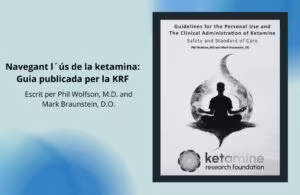
Portada de la guía de la KRF escrita por Phil Wolfson y Mark Braunstein

Guidelines for ketamine safety and clinical use: Ketamine Research Foundation recommendations

The Ketamine Research Foundation, led by Dr. Phil Wolfson, has published a comprehensive guide for the safe and ethical use of ketamine. The document addresses responsible personal use, clinical application within ketamine-assisted psychotherapy, and a professional ethical code developed by the Ketamine Psychotherapy Associates. It offers practical guidance for preparation, accompaniment, and integration, aiming to minimize risks and maximize therapeutic benefit. The guide reinforces KRF’s leadership in setting high ethical, clinical, and educational standards for ketamine-assisted therapy worldwide.

...
Hands cradling a lit candle in the dark

Ketamine-assisted therapy in the treatment of grief for the loss of a loved one

Prolonged or complicated grief affects around 10% of bereaved people and is marked by persistent longing, intense emotional distress, and functional impairment. Current evidence shows only moderate benefits from psychotherapy and no proven efficacy of medication alone. Recent research highlights psychedelic-assisted therapies as promising alternatives. Ketamine-assisted therapy may support grief treatment through two complementary mechanisms: a neurobiological window of enhanced neuroplasticity that increases psychological flexibility, and meaningful altered-state experiences that facilitate acceptance, emotional processing, and the reconstruction of personal narratives around loss.

...
Antique botanical illustration of several mushrooms on moss

Psilocybin and depression

Psilocybin-assisted therapy is emerging as a promising approach for depression, particularly treatment-resistant cases where standard antidepressants show limited efficacy and burdensome side effects. Research suggests psilocybin can produce rapid and sustained reductions in depressive symptoms, partly by enhancing neuroplasticity and facilitating meaningful psychological experiences. When embedded in a structured therapeutic model with preparation, dosing, and integration sessions, psilocybin may foster emotional openness, cognitive flexibility, and long-term positive change, highlighting a potential paradigm shift in how depression is treated within modern clinical research frameworks.

...
Headphones, speakers and an eye mask on wooden tables for music in psychedelic sessions

Music in psychedelic-assisted therapy

Music has played a central role in psychedelic practices for centuries and is now recognized as a key therapeutic component in psychedelic-assisted therapy. Research shows that psychedelics heighten emotional responsiveness to music, transforming it into an active guide for inner exploration. Carefully selected music can evoke deep emotions, access unconscious material, and support transformative or mystical experiences. By amplifying emotional processing and reducing psychological defenses, music helps patients surrender to the experience, facilitating insight, emotional release, and therapeutic change that is difficult to reach through verbal therapy alone.

...
Cholla cactus backlit at sunset in the desert

Ketamine for chronic neuropathic pain

Chronic neuropathic pain is often severe, persistent, and poorly responsive to conventional treatments such as anti-inflammatories or opioids. Ketamine has emerged as a promising option by modulating NMDA receptors involved in pain perception and memory. Clinical studies show that ketamine can significantly reduce pain for weeks, particularly in complex neuropathic conditions. Beyond analgesia, ketamine may also improve comorbid depression and PTSD, which frequently accompany chronic pain. When combined with psychotherapy, ketamine offers an integrative approach addressing both physical suffering and psychological distress.

...
Underwater bubbles lit by sunlight

Fear, trauma and MDMA

Fear is a fundamental emotion that protects us, but when it becomes chronic it can lead to disorders such as phobias and post-traumatic stress disorder (PTSD). Conventional treatments often show limited efficacy, prompting new approaches like MDMA-assisted psychotherapy. Research promoted by Multidisciplinary Association for Psychedelic Studies (MAPS) and led by figures such as Rick Doblin suggests that MDMA can reduce fear responses, enhance emotional processing, and strengthen the therapeutic alliance. These effects may allow patients to revisit traumatic memories with less avoidance, fostering recovery and improved quality of life.

...