

Most of us have experienced days when a single emotion seems to take over everything.It may be anger after an argument. Sadness following a loss. Anxiety before an important meeting. Or frustration when things do not turn out as we had hoped.
When this happens, it is natural to try to control what we feel. We tell ourselves that we should not be angry, that there is no reason to worry so much, or that we should be able to get over it quickly.
But there is a problem: emotions do not usually disappear simply because we reject them.
In fact, the opposite is often true. The more we try not to feel an emotion, the more space it tends to occupy in our minds. Constantly struggling against what we feel can become exhausting and create even more frustration.
Emotions Are Not the Enemy
This perspective aligns with what several contemporary therapeutic approaches, including Acceptance and Commitment Therapy (ACT), have observed: persistent attempts to eliminate or control unpleasant inner experiences often increase psychological suffering.
Fear prepares us to face potential threats. Anger alerts us when we perceive injustice or when an important boundary has been crossed. Sadness may arise when we lose something valuable. Joy connects us with what gives meaning to our lives.
Emotions are neither good nor bad. They are part of being human.
Often, our suffering comes not so much from the emotion itself, but from our efforts to avoid it, suppress it, or prevent it from appearing.
For this reason, one of the most valuable psychological skills is the ability to recognize emotions when they arise, allow them to be present, and consciously choose how we want to act in their presence.
An Ancient Wisdom: The Practice of Navarasa
Long before modern psychology began speaking about emotional acceptance, some Indian traditions had already developed remarkably sophisticated ways of relating to emotional experience.
One of these traditions is Navarasa.
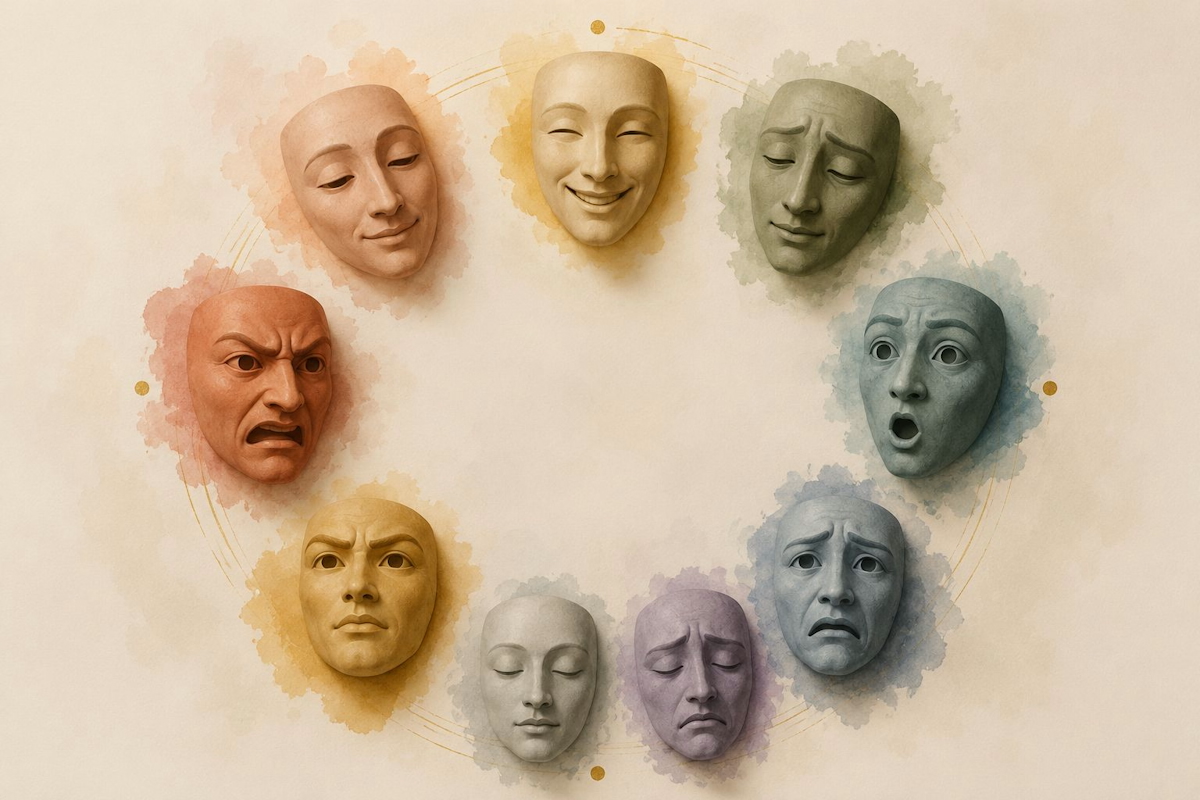
The Sanskrit word rasa can be roughly translated as “emotional essence” or “emotional flavor.” According to this tradition, there are nine fundamental emotional states that form part of human experience: love, joy, compassion, courage, surprise, calmness, as well as anger, fear, and sadness.
The purpose of Navarasa is not to eliminate unpleasant emotions or replace them with positive ones.
The idea is almost the opposite. It is about recognizing that all emotions belong to human life and training ourselves to make room for them consciously.
Greeting Emotions Before They Arrive
Some practices inspired by Navarasa invite us to spend a few minutes each morning intentionally connecting with each of these emotional states.
The goal is not to intensify them or become absorbed by them. Rather, it is simply to remember that they exist and that any one of them may arise at some point during the day.
When an emotion appears later, it is no longer an unexpected visitor. It is a familiar presence.We can acknowledge it and say to ourselves:
“Yes, I know who you are. I’ve already seen you today. You are welcome to be here, but you do not have to make all my decisions for me.”
This attitude does not remove discomfort, but it often reduces the unnecessary struggle against it.
Making Space in Order to Choose
Accepting an emotion does not mean resigning ourselves to it or agreeing with it. Acceptance simply means recognizing that it is present.
When we stop spending energy trying to push away what we feel, we have more resources available to decide how we want to act.
Fear can be present, and we can still take the important step.
Anger can be present, and we can still respond with calm.
Sadness can be present, and we can still care for what matters most to us.
Perhaps this is one of the most valuable insights shared by both ancient traditions and modern psychology: freedom is not about never experiencing difficult emotions, but about being able to live fully even when they are present.
Emotions are part of life. The question is not how to avoid them, but how to relate to them in a more open, flexible, and conscious way.
Tomorrow morning, take two minutes to imagine the different emotions that might accompany you throughout the day. Do not try to create them. Simply acknowledge that they all have a place within the human experience. When one of them appears, notice whether you can welcome it with a little less surprise and a little less resistance.