
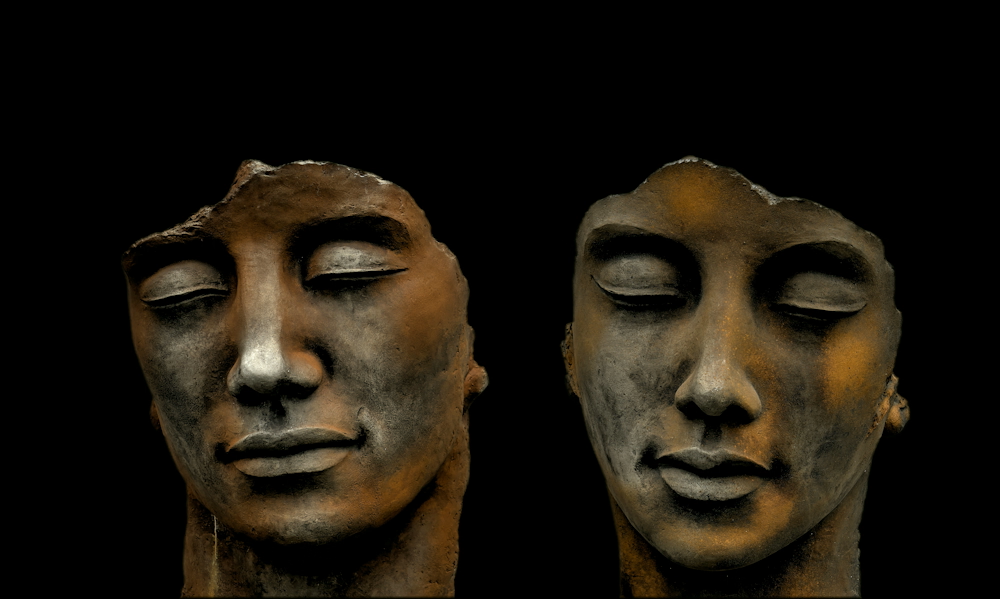

For centuries, the human “self” was treated as a finished product. From Hippocrates’ ancient theories of bodily humors to the foundations of modern psychometrics, the prevailing consensus has been that personality is a collection of stable traits, enduring patterns of thought, feeling, and behavior that remain relatively fixed once we reach adulthood. While we might refine our habits or learn new skills, the core psychological architecture of who we are was long thought to be set in stone.
However, we are currently navigating a “Psychedelic Renaissance” that fundamentally challenges this status quo. A landmark systematic review by Anna Beatriz Vicentini, from the Phantastica laboratory directed by Dr. Rafael Guimarães dos Santos at the University of São Paulo at Ribeirão Preto, Brazil, and in collaboration with Dr. José Carlos Bouso, Scientific Director at Clínica Synaptica, meticulously analyzed 48 recent studies on classic psychedelics. Their findings suggest that our internal architecture is far more malleable than previously imagined. By synthesizing data on substances like psilocybin, LSD, and ayahuasca, researchers are discovering that these compounds do not just produce temporary “trips”, they may actually catalyze the rewiring of the fundamental traits that define us.
Here are five key takeaways from the latest research on how psychedelics are reshaping our understanding of human personality.
1. The “Malleability” of Openness and Neuroticism
In modern psychology, the Five-Factor Model (FFM) serves as the “integrating matrix” for personality theory, organizing human character into five broad dimensions: Openness, Neuroticism, Extraversion, Agreeableness, and Conscientiousness. Historically, these were viewed as fixed points on a compass. However, the Vicentini review highlights a consistent shift following psychedelic intervention, specifically, a significant increase in “Openness” and a decrease in “Neuroticism.”
Openness reflects curiosity and receptivity to new ideas, while Neuroticism governs how we manage negative emotions; lower scores in the latter reflect greater emotional stability. While these shifts are well-documented with psilocybin, the data for ayahuasca remains more nuanced. In naturalistic, observational settings, ayahuasca users consistently show improved emotional stability. However, experimental, placebo-controlled trials have occasionally yielded mixed or null findings, highlighting a tension between the rigid structure of the lab and the ritualistic power of traditional settings.
Overall, classic psychedelics seem to promote lasting personality changes, most consistently increasing Openness and reducing Neuroticism.
2. Your Personality is the “Set” that Predicts the “Setting”
In psychedelic research, the “Set and Setting” framework suggests that the experience is shaped by the user’s internal state (set) and the environment (setting). The latest research clarifies that our baseline personality traits are the primary “set” that determines the trajectory of the experience. The “trip” is rarely random; it acts as a mirror of the user’s existing psychological structure:
· High Neuroticism: Individuals scoring high in this trait at baseline are significantly more prone to “challenging experiences,” such as emotional turbulence or the dread of ego dissolution.
· High Openness and Self-Transcendence: Those who enter the experience with these traits are more likely to report mystical-type experiences and find deep personal meaning in the session.
· Extraversion: This trait often correlates with more intense perceptual alterations and a higher degree of enjoyment during the acute psychedelic state.
· Impulsivity: Higher baseline impulsivity is associated with more unpredictable and occasionally less favorable outcomes.
3. The LSD “Sleeper Effect” on Conscientiousness
One of the most striking findings in the recent literature involves the “delayed fuse” of personality change. In most medical interventions, we expect to see results immediately. However, studies on LSD—notably by Schmid and Liechti (2018) and Holze et al. (2024)—uncovered a surprising temporal gap.
When researchers assessed participants one month after an LSD session, they often found no significant changes in personality traits. Yet, when they followed up with the same participants 12 months later, significant increases in Conscientiousness—the trait associated with self-discipline and goal-directed behavior—and Extraversion finally manifested. This suggests that the “rewiring” of certain complex behaviors may take a full year of integration before it becomes visible in a person’s daily life.
4. Microdosing is Reshaping “Absorption”
The trend of microdosing—taking sub-perceptual doses of psychedelics—has also been subjected to scientific scrutiny. Research by Anderson et al. (2019) and Polito et al. (2019) found that even these minute doses can shift a specific trait known as “Absorption.”
Measured via the Tellegen Absorption Scale (TAS), Absorption is the tendency to become deeply, almost effortlessly immersed in sensory experiences, mental imagery, or nature. While microdosing consistently increases this capacity for immersion and reduces negative emotionality, the data also reveals unexpected complexity. In certain contexts, Polito et al. (2019) observed a slight increase in Neuroticism among microdosers. This suggests that while microdosing may heighten our connection to the world, it can also increase emotional sensitivity in ways that require careful management.
5. The Biological Architect: The 5-HT2A Receptor
What is the biological ground zero for these personality shifts? The research points to the cortical serotonergic 5-HT2A receptor. These receptors are densely concentrated in the fronto-temporo-parieto-occipital areas of the brain—regions responsible for high-level sensory processing and self-referential thought.
A landmark study by Preller et al. (2018) proved this by using a pharmacological blocker (ketanserin). When participants were given this blocker to prevent LSD from activating the 5-HT2A receptors, the psychedelic effects vanished entirely. This suggests that the activation of this specific receptor is the necessary catalyst for the entire chain of transformation.
A New Frontier of Human Potential
As the field of psychedelic science matures, we are moving away from anecdotal evidence toward standardized tools like the Five-Factor Model. However, a significant challenge remains: the tension between nomothetic (group-level) data and idiographic (individual) experience. While we can predict broad trends, we are still learning how to capture the unique, person-specific psychological dynamics that unfold during a psychedelic experience.
This research brings us to a profound ethical and philosophical crossroads. If personality is no longer a fixed trait but a variable that can be adjusted, what does it mean for our sense of “self”? As we gain the ability to choose a more open or less neurotic version of ourselves through pharmacological intervention, we must weigh the clinical benefits against the deep personal implications of intentionally reshaping who we are. Are we fixing a broken self, or are we simply choosing a new one?
REFERENCE
Vicentini, A. B., de Paula, C. C., Silva Reis, J. A., Bouso, J. C., Hallak, J. E. C., & Dos Santos, R. G. (2026). Classic psychedelics and personality: An updated systematic review. Journal of Psychopharmacology. Publicación en línea anticipada. https://doi.org/10.1177/02698811261449386